
Do Cadillac LYRIQ Driving Modes Change Range or Battery Usage? What Owners Should Know
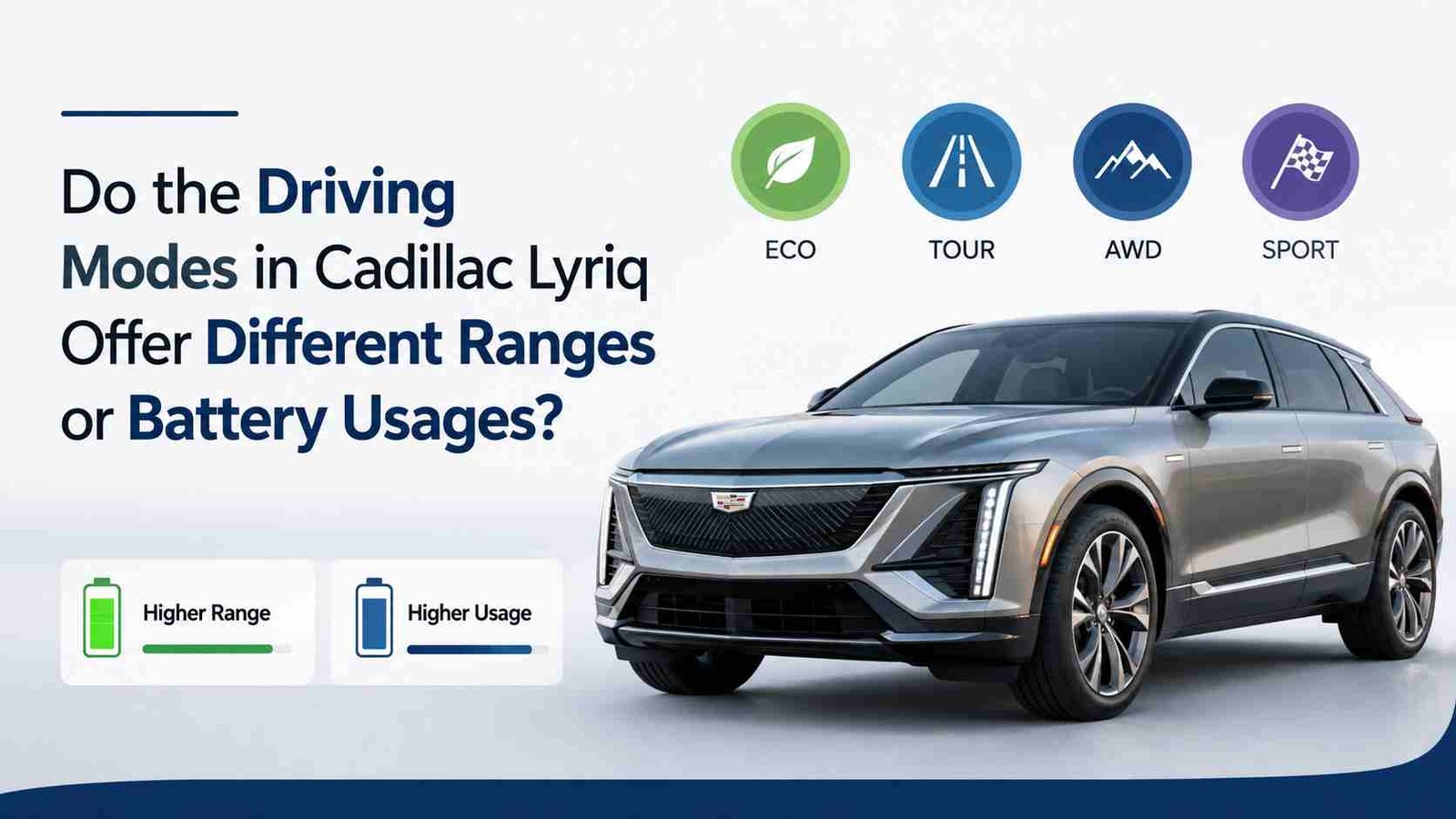
You switch your LYRIQ to Sport, glance at the dash, and suddenly the estimated range drops by 15 miles. Panic sets in.
Did you just lose battery? Not exactly.
This is one of the most common questions LYRIQ drivers ask, and the answer is more interesting than a simple yes or no.
Here’s what you’ll learn: whether the driving modes actually give you different ranges, what really changes when you switch modes, and how to squeeze the most miles out of every charge.
Let’s get into it.
Quick Answer: Do LYRIQ Driving Modes Change Your Range?
No the driving modes do not give your Cadillac LYRIQ separate official range ratings, and they don’t change the size of your battery.
What they do change is how the car delivers power, responds to your foot, and manages regenerative braking.
That means your real-world energy use can shift a little depending on the mode you pick.
But here’s the part most people miss: your driving style, speed, and the weather outside affect your range far more than the mode ever will.
So switching from Tour to Sport won’t magically shrink your battery. It just changes how you’re likely to drive.
Now let’s unpack why.
How the LYRIQ Battery Actually Works
Before we talk modes, we need to talk about the battery — because that’s where the confusion starts.
Every Cadillac LYRIQ runs on GM’s Ultium platform with a 102 kWh battery pack. That capacity is fixed.
Think of it like a fuel tank. Whether you’re driving gently or flooring it, the tank holds the same amount of “fuel.”
What changes is how fast you empty it.
The EPA range figures you see — up to 326 miles for the rear-wheel-drive model and around 319 for all-wheel-drive — apply to the vehicle configuration, not to any single mode.
There’s no “Tour Mode range” or “Sport Mode range” printed on the window sticker. That’s just not how it works.
Here’s the key distinction to hold onto: capacity is fixed, but consumption is variable.
Your battery always stores the same energy. How quickly you use it is up to you, your conditions, and yes, a little bit of your mode choice.
If you’re still weighing the LYRIQ against rivals, our luxury electric SUVs comparison breaks down how it stacks up on range and efficiency.
What Each LYRIQ Driving Mode Actually Does
The LYRIQ gives you four standard driving modes: Tour, Sport, Snow/Ice, and My Mode.
None of them swap out hardware. They’re software calibrations — think of them as different personalities for the same car.
When you pick a mode, the car adjusts a handful of systems at once. That includes throttle mapping (how your pedal input translates to power), steering effort, regenerative braking behavior, and traction or all-wheel-drive torque distribution.
If you’re shopping the high-performance LYRIQ-V, you’ll also find dedicated performance modes like Velocity Max. Those unlock maximum output for short bursts, and they’re built for track fun, not daily commuting.
Here’s a quick overview so you can see the differences at a glance:
| Mode | Main Purpose | Driving Feel | Best Use Case |
|---|---|---|---|
| Tour | Everyday comfort and efficiency | Smooth, relaxed throttle | Commuting and highway cruising |
| Sport | Sharper response and performance | Quick, firm, lively | Merging, passing, spirited drives |
| Snow/Ice | Traction on slippery roads | Gentle, controlled power | Snow, ice, or slush |
| My Mode | Fully personalized | Whatever you set it to | Drivers who want a custom blend |
Now let’s look at each one in detail, starting with the mode you’ll probably use most.
Tour Mode: The Everyday Efficiency Setting
Tour is the LYRIQ’s default, and honestly, it’s the one you’ll want for most of your driving.
Cadillac tuned it to feel smooth and balanced. The throttle response is softer, so power builds gradually instead of slamming in the moment you touch the pedal.
That gentle calibration naturally encourages efficient driving. You accelerate more smoothly, which means the motor sips energy rather than gulping it.
Regenerative braking also works effectively in Tour, so you recover more energy every time you slow down.
Picture your morning commute. You leave a stoplight, ease up to speed, and coast toward the next red light. In Tour, that whole rhythm feels effortless — and it’s kind on your battery.
One honest caveat: Tour encourages efficiency, but it doesn’t guarantee maximum range on every single trip. If you drive Tour aggressively at 80 mph, you’ll still burn through miles fast.
Still, for daily driving, Tour is your best friend.
Sport Mode: More Response, Not a Battery Drain Switch
Sport gets a bad reputation, and it’s mostly undeserved.
When you switch to Sport, the LYRIQ sharpens its throttle mapping and adds weight to the steering. Small pedal inputs now produce bigger, quicker bursts of torque.
The result? The SUV feels alive. Merging onto a busy highway or overtaking a slow truck becomes genuinely fun.
Here’s the thing everyone gets wrong: Sport Mode itself doesn’t drain your battery. Hard acceleration does.
The mode simply makes it easier — and more tempting — to drive with a heavy foot. If you switch to Sport but drive gently, your energy use stays remarkably close to Tour.
Think of two drivers in identical LYRIQs. One is in Sport but cruises calmly at 65 mph. The other is in Tour but launches hard at every green light. The calm Sport driver may actually use less energy.
You’ll notice I’m not quoting a fixed percentage of range loss for Sport. That’s deliberate.
Real efficiency depends on speed, temperature, terrain, and your right foot — so any single number would mislead you.
One more reassurance: using Sport occasionally does not harm your battery’s long-term health. Drive it, enjoy it, then switch back when you’re cruising.
Snow/Ice Mode: Traction First, Range Second
Snow/Ice Mode has one job, and it’s not saving energy — it’s keeping you safe.
This mode softens accelerator response to prevent wheel spin on slippery surfaces. It also adjusts how torque gets delivered so your tires can actually grip the road.
If you’ve ever felt your wheels slip pulling out of a snowy driveway, you know why this matters. Snow/Ice smooths that power out so you move forward with control instead of spinning.
Now, here’s where owners often get confused. Many blame Snow/Ice Mode for their shrinking winter range.
But the real culprit is the cold weather itself, not the mode.
Cold temperatures slow down the battery’s chemistry, and your cabin heater pulls serious power. Those two factors do far more damage to your range than any mode setting.
So use Snow/Ice only when the road is actually slippery. On dry pavement, it offers no benefit and just softens your throttle unnecessarily.
A smarter winter strategy? Precondition your cabin and battery while you’re still plugged in. That way you warm things up using grid power instead of your battery. Our guide on how to maximize EV range covers more cold-weather tactics.
My Mode: Personalize Your Balance of Comfort and Performance
My Mode is the LYRIQ’s secret weapon, and it’s the one most articles gloss over.
It lets you customize individual settings — accelerator feel, steering effort, braking response, and more. Instead of picking a preset, you build your own.
This solves a real problem. Maybe you love Sport’s sharp steering but hate its jumpy throttle. With My Mode, you can have the steering you want and keep a smoother pedal.
Set it up with a softer throttle and strong regen, and it behaves a lot like Tour — efficient and calm. Dial in a sharper response, and it edges closer to Sport.
Here’s a practical tip: find one setup that fits your daily driving and save it. Consistency means fewer erratic throttle inputs, and smoother inputs mean better efficiency over time.
Think of My Mode as your personal middle ground. You get the responsiveness you enjoy without constantly flipping between presets.
Why Your Range Estimate Changes After Switching Modes
Let’s tackle the moment that started this whole article — that range number dropping when you switch to Sport.
Here’s what’s really happening.
The estimated range on your dashboard is a prediction, not a fixed measurement. The car looks at your recent driving efficiency and calculates how far you can go based on that pattern.
When you switch to Sport, the LYRIQ anticipates that you’ll probably drive more aggressively. So it adjusts the estimate downward — sometimes before you’ve even pressed the pedal.
Flip back to Tour, drive smoothly for a while, and you’ll often see the estimate climb back up.
This is the crucial part: a changing estimate does not mean your battery gained or lost capacity. Your 102 kWh pack holds exactly what it held a minute ago.
It helps to separate a few different numbers in your head:
- EPA range — the official lab-tested figure for your configuration
- Estimated miles — the dashboard’s live prediction based on recent behavior
- Actual mi/kWh — your true efficiency, visible over a full trip
- Battery percentage — how much energy you have left, plain and simple
Once you understand that the estimate is just a smart guess, that scary drop stops being scary. It’s the car adapting, not your battery shrinking.
What Affects LYRIQ Range More Than Driving Mode
If you really want more miles, focus your energy here. These factors matter far more than which mode you pick.
Here’s the ranked list, from biggest impact to smallest:
1. Highway speed. This is the big one. Aerodynamic drag rises sharply as you go faster, so cruising at 80 mph burns way more energy than 65 mph — regardless of mode.
2. Outside temperature and climate control. Cold weather hurts battery performance, and running the heater or AC pulls power directly from the pack. Winter can slash range dramatically.
3. Wheel and tire choice. Larger wheels look great but add rolling resistance and weight. The bigger 22-inch wheels can quietly cost you miles compared to smaller options.
4. Tire pressure and maintenance. Underinflated tires drag more and waste energy. A quick pressure check can genuinely recover lost range.
5. Terrain and elevation. Climbing hills eats energy fast. Flat highways are far friendlier to your battery than mountain passes.
6. Driving aggression. Hard launches and heavy braking waste energy no matter which mode you’re in.
7. Drive mode selection. Yes, it’s last. Mode choice amplifies or softens the factors above — but it rarely overrides them.
The takeaway? If you’re chasing range, slow down on the highway before you worry about your mode.
How Driving Style Shapes Your Real-World Efficiency
Here’s a truth that ties everything together: modes affect your range mostly by changing how you drive.
Sport invites harder launches because the throttle begs for it. Tour and Snow/Ice encourage smoother inputs because power builds gently.
But the pedal is still under your control.
Smooth, anticipatory driving beats any mode setting. If you lift off the accelerator early and let regenerative braking slow you down, you recover energy that a late braker just throws away as heat.
Picture two neighbors with identical LYRIQs, driving the same route to work. One coasts toward stoplights and eases into speed. The other races between lights and brakes hard.
Same car, same road, same weather — but wildly different range at the end of the week. That difference is driving style, not mode.
Want to get better at capturing that lost energy? Our breakdown of regenerative braking explained shows exactly how one-pedal driving works.
Best LYRIQ Driving Mode for Each Situation
Enough theory — let’s make this practical. Here’s which mode to reach for in real situations.
| Situation | Recommended Mode | Why |
|---|---|---|
| City commuting | Tour or efficiency-tuned My Mode | Smooth throttle plus one-pedal driving saves energy |
| Highway cruising | Tour | Steady, moderate speeds maximize range |
| Winter / slippery roads | Snow/Ice | Traction and control come first |
| Wet but not icy roads | Tour | Usually plenty of grip; Snow/Ice only if traction worries you |
| Merging or passing | Sport (briefly) | Quick torque when you need it, then switch back |
| Long road trips | Tour, with Sport for passing | Steady efficiency plus power on demand |
Notice the pattern? Tour handles most of your life. Sport is a tool you grab for a few seconds, then put away.
Snow/Ice comes out only when the road demands it. And My Mode is there when you want your own custom flavor.
Practical Tips to Maximize Range in Your LYRIQ
Ready to stretch every charge? Try these, starting with the ones that matter most.
Use Tour as your daily default. It delivers the best efficiency in nearly all conditions, so there’s no reason to overthink it.
Keep your highway speed moderate. Dropping from 80 to 65 mph can add serious miles. This is the single easiest win.
Lean on regenerative braking. Enable one-pedal driving in traffic and use it on downhill stretches to recover energy you’d otherwise lose.
Check your tire pressure. Keep tires inflated to spec, and if range is your priority, consider smaller wheels over the 22-inch option.
Precondition in cold weather. Warm the cabin and battery while plugged in so your heater doesn’t drain the pack once you’re driving.
Charge to around 80% for daily use. This preserves battery health and leaves room for regenerative braking to top things off. If you’re new to charging habits, our guide on how EV charging works walks through the basics.
Don’t judge a mode from a five-minute test. Efficiency reveals itself over a full trip, not a quick drive around the block.
Common Myths About LYRIQ Driving Modes
Misinformation spreads fast in EV forums. Let’s clear up the big ones.
Myth: Sport Mode permanently reduces your battery capacity.
Reality: It only increases energy draw when you actually drive harder. Your capacity stays fixed.
Myth: Tour Mode increases the battery’s size or official range.
Reality: It just encourages smoother driving. The battery and EPA numbers don’t change.
Myth: Snow/Ice Mode slashes your range.
Reality: Cold weather is the real culprit. The mode barely affects consumption on its own.
Myth: Each mode has its own official range rating.
Reality: EPA range applies to your configuration — RWD or AWD — not to any individual mode.
Myth: Regenerative braking creates free energy.
Reality: It recovers some energy that would otherwise be lost as heat. Helpful, but not magic.
FAQs
Do Cadillac LYRIQ driving modes change the official EPA range?
No. EPA range is set for your configuration — up to 326 miles for RWD and around 319 for AWD. Modes affect real-world consumption, not the official figure.
Does Sport Mode reduce the LYRIQ’s driving range?
Only indirectly. Sport sharpens throttle response, which tempts harder acceleration. Drive gently in Sport and your energy use stays close to Tour.
Which LYRIQ mode is best for everyday driving?
Tour. It balances comfort, smooth power delivery, and efficiency for daily commutes and highway trips.
Does Snow/Ice Mode save battery power?
Not really. It’s built for traction and safety, not efficiency. Cold weather, not the mode, is what shrinks your winter range.
Can My Mode improve efficiency?
Yes, if you configure it with a softer throttle and strong regen, then drive smoothly. Your settings and habits matter more than the label.
Why does my LYRIQ range estimate drop after switching modes?
The estimate is a live prediction based on recent driving. Switching to Sport lowers it because the car expects harder driving — but your battery capacity hasn’t changed.
Can I switch driving modes while driving?
Yes. You can change modes at normal speeds through the center touchscreen.
Does using Sport Mode harm the battery over time?
No. Occasional Sport use increases energy draw but causes no long-term harm. Sensible charging habits matter far more for battery health.e.






Finding a casino that truly understands what we need locally is tough but this one nails it every time. The local payment options make funding my account effortless and payouts hit my wallet within minutes. The game library is loaded with fan favorites and the live dealers add such a fun vibe. I tell all my friends about this hidden gem. phiq7777
If you miss the excitement of sitting right next to a live dealer this platform captures that magic perfectly on your screen. I love how the stream quality stays clear even during peak hours and the chat feature makes me feel like I am playing alongside real friends. Payouts arrive on time and the whole experience feels completely transparent. mm777live
The whole atmosphere reminds me of walking into a premium lounge where every detail is handled with care. From the sleek dashboard design to the dedicated account manager who remembers my preferences this platform genuinely stands out. You will notice how much effort goes into making each session comfortable. Enjoy the experience at auvegasworld
Just had a great run tonight! The games load fast and everything feels very professional. Definitely checking out vio777 again tomorrow.
I have tried quite a few platforms over the years and this one stands out for its fairness and transparency. The payment methods are flexible and work perfectly with our local banks. I appreciate the straightforward approach without any hidden tricks. It is refreshing to play somewhere that respects the player. tk888casino
I rely on accurate tips and reliable analytics before placing my wagers and this platform never disappoints. The predictions are well researched and the odds are genuinely competitive compared to other sites I have tested. It feels like having a seasoned professional by my side. Get your predictions at sportytraderpronosticos
Finally found a platform that actually cares about what we want at mysgamemy. The regular updates keep things fresh and the reward system stacks up nicely without any sketchy fine print. A genuinely player friendly home base. mysgamemy
I have been searching for a trustworthy betting platform for a long time and I finally found my home here. The games are fair and the withdrawals are always on time. Every spin feels like a small celebration and I love how smoothly everything works. Thank you for making my gaming days so enjoyable. fairplayclub1
Navigating this site is a breeze and I really enjoy how straightforward the login process is for daily players. I have been placing my bets here for weeks and the experience remains consistently smooth from deposits to cashouts. ilotbetcasinologin
Dreaming of becoming a superphvip someday! What perks do they even get? Probably just more opportunities to spend money… but hey, a guy can dream, right?